
Program of Service Committee
Governance Committee
Executive Committee
Thumbnail
Why is Charlotte called the Queen City?
September 4, 2019
Charlotte, North Carolina, was first settled after colonists made their way down the Great Wagon Road. Northern colonies in Pennsylvania, Maryland and Virginia had become crowded, so settlers went south to seek religious and economic freedom, as well as to take advantage of quality farmland. Native Americans used this trail for hunting, trading, and war long before the settlers used it to migrate south. The Native Americans named the trail “Warriors Path.”
Conestoga Wagon, courtesy of Wikimedia.
Before Charlotte was chartered in 1768 by the colonial North Carolina General Assembly, settlers called the area “Charlottetowne” after Queen Charlotte Sophia of Mecklenburg-Strelitz. The settlers sought to honor Queen Charlotte’s husband, King George III, as well as to sway Assemblymen into making Charlotte the site of the county courthouse as a political bid. Courthouses enabled cities to grow economically by serving as a hub for visitors and business during quarterly sessions. The Assemblymen chartered the city of Charlotte in 1768 and entitled the city to a courthouse and a prison.
The charter reads:
“Be it therefore Enacted, by the Governor, Council, and Assembly, and by the Authority of the same, That the said Three Hundred and Sixty Acres of Land, so laid off by the Commissioners or Trustees as aforesaid, be, and the same is hereby constituted, erected, and established, a Town and Town Common, and shall be called by the name of Charlotte.”
-- Acts of the North Carolina General Assembly, 1768; North Carolina. General Assembly; November 07, 1768 - December 05, 1768; Volume 23, Pages 759-783; CHAPTER XI.
1766- The First Mecklenburg County Courthouse (modern interpretation). Courtesy of the Robinson-Spangler Carolina Room.
Mecklenburg County, the county in which the city of Charlotte exists, was also named in honor of Queen Charlotte. Charlotte’s birthplace was Mecklenburg-Strelitz, which is a province in present-day northern Germany. Queen Charlotte never actually visited our city, but one of her handwritten letters is housed at the Robinson-Spangler Carolina Room in the Main Library:
Queen Charlotte Letter, 1812. Courtesy of Charlotte Mecklenburg Library, Robinson-Spangler Carolina Room.
Who was Queen Charlotte anyway?
George III (1738-1820), Queen Charlotte (1744-1818) and their Six Eldest Children. Courtesy of Zoffany Royal Collection Trust/© Her Majesty Queen Elizabeth II, 2014.
Queen Charlotte Sophia was born in Mecklenburg-Strelitz (in the Holy Roman Empire) in 1744, to Duke Charles Louis Frederick of Mecklenburg and Princess Elisabeth Albertine of Saxe-Hildburghausen. As a child, she was educated by a priest in botany, natural history and language, but focused her studies in housekeeping and religion. As demonstrated by the letter above, Charlotte learned how to read and write. These were rare skills for women during that time—her royal status permitted her to have access to education through multiple tutors.
Unfinished portrait depicting the marriage of George III to Charlotte of Mecklenburg-Strelitz on 8 September 1761, Sir Joshua Reynolds. Courtesy of Royal Collection Trust.
At 17 years old in 1761, Charlotte was engaged to King George III. She was an attractive option to wed because she was born in an “insignificant” part of Europe and would likely have no interest in politics; she was instructed by George III after their wedding “not to meddle” in politics, which she obeyed. However, she did have indirect political influence—she used her closeness to George III to keep herself informed and to recommend office appointments, as well as keep German interests in mind. She did not speak English at first but learned quickly. One observer commented, "She is timid at first but talks a lot, when she is among people she knows."
View of Buckingham House from WH Pyne, The History of the Royal Residences, 1819 (Courtesy of the British Library).
Although St. James Palace was the official Royal residence, Queen Charlotte fell in love with Buckingham House, which she and George III moved into shortly after purchasing. She gave birth to 14 of her 15 children in the house that eventually became known as “The Queen’s House.” This property is now popularly known as Buckingham Palace.
Wolfgang Amadeus Mozart Opus 3 Dedication Page. Courtesy of Bibliorare.
Queen Charlotte had a passion for music, so she brought a harpsichord with her from Germany and took lessons from Johann Christian Bach, son of Johann Sebastian Bach. Wolfgang Amadeus Mozart once played the organ as Queen Charlotte sang on a family trip to England when he was 8 years old. Mozart later dedicated his Opus 3 to his beloved queen. On the dedication page he wrote, “Filled with pride and joy at daring to offer you a tribute, I was finishing up these sonatas to be laid at the feet of your Majesty [Queen Charlotte]; I was, I confess, drunk with vanity and thrilled with myself, when I spied the Genius of Music at my side.”
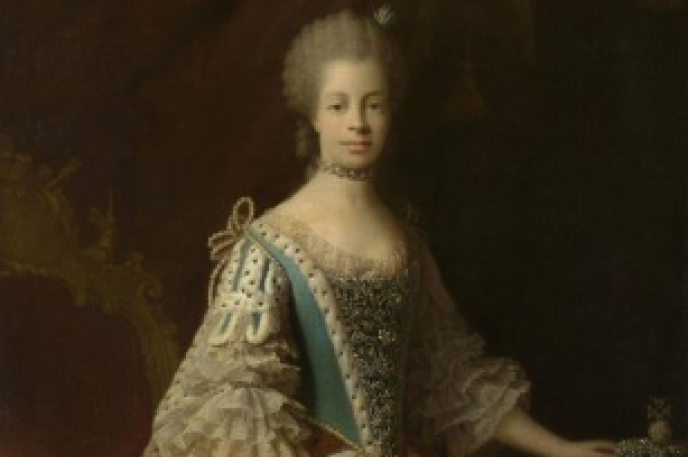
Queen Charlotte (1744-1818) by Sir Allan Ramsay, ca. 1761-1769. Courtesy of Royal Collection Trust, https://www.rct.uk/collection/402413/queen-charlotte-1744-1818
According to some genealogists, Queen Charlotte is informally considered the second biracial Queen of England. She was purportedly a direct descendent of Margarita de Castro e Sousa, a member of the African branch of the Portuguese Royal House. Early portraits of the Queen show that Charlotte had hints of African physical attributes. Sir Allan Ramsay painted many portraits of Queen Charlotte, seen above. Writings from the period also alluded to her “mulatto” appearance, meaning “one with mixed black and white ancestry.”
As anti-slavery movements in England became more prevalent, royal portrait painters were instructed to soften “undesirable” features in their subjects’ faces. This included making Queen Charlotte’s skin tone appear lighter and manipulating other physical features. In fact, Ramsay’s Coronation portrait of Charlotte was distributed in England and the colonies to subtly stoke anti-slavery sentiment due to the prevalence of Charlotte’s African features.
A photo of Kew Gardens, the royal botanical garden Queen Charlotte helped maintain. Photo by Kew Gardens.
Queen Charlotte had a keen interest in botany and played a large role in expanding and preserving Kew Gardens, the Royal botanical gardens in Kew, England. She was known by the British public as the “Queen of Botany,” and botanists named the Bird of Paradise, a flower native to South Africa, the Strelitzia reginae in her honor. Charlotte turned to botany when she struggled with her mental health, which is when she planned the gardens of the Frogmore House in Windsor.
Queen Charlotte was also a philanthropist, founding several orphanages in England. She founded and was named the Patron of the General Lying-in Hospital in London, which was later named The Queen’s Hospital and is now known as The Queen Charlotte’s and Chelsea Hospital. Queen Charlotte was also known to offer aid to poor families, as well as helped struggling musicians.
--
Sources:
Blakemore, Erin. “Meghan Markle Might Not Be the First Mixed-Race British Royal.” History. https://www.history.com/news/biracial-royalty-meghan-markle-queen-charlotte. Accessed August 2019.
Cooper, Jean L. and Angelika S. Powell. “Queen Charlotte’s Letters.” http://people.virginia.edu/~jlc5f/charlotte/letter_intro.html. Accessed August 2019.
“England’s 18th Century Black Queen, Sophie Charlotte born.” AAREG. https://aaregistry.org/story/englands-first-black-queen-sophie-charlotte-born/. Accessed August 2019.
Fraser, Flora. “Princesses: The Six Daughters of George III.” New York: Knopf, 2005. (CML Call No. 941.073 Fraser)
Hanchett, Tom. “The History of Charlotte.” Charlotte. https://www.charlottesgotalot.com/articles/history/the-history-of-charlotte. Accessed August 2019.
Hedley, Olwen. “Queen Charlotte.” London: J. Murray, 1875. (NCR B C479c H455)
“History Timeline, Rural Beginnings 1730-1772, 1776- The First Mecklenburg County Courthouse.” Charlotte Mecklenburg Story. https://www.cmstory.org/exhibits/history-timeline-rural-beginnings-1730-1772/1766-first-mecklenburg-county-courthouse. Accessed August 2019.
“History Timeline, Rural Beginnings 1730-1772, 1768- Charlotte Chartered.” Charlotte Mecklenburg Story. https://www.cmstory.org/exhibits/history-timeline-rural-beginnings-1730-1772/1768-charlotte-chartered. Accessed August 2019.
Jackson, Marshall R., III. “Great Wagon Road.” NCPedia. https://www.ncpedia.org/great-wagon-road. Accessed August 2019.
“Queen Charlotte (19 May 1744- 17 November 1818.” The Royal Family. https://www.royal.uk/. Accessed August 2019.
Valdes y Cocom, Mario de. “The Blurred Racial Lines of Famous Families: Queen Charlotte.” South Carolina etv. https://www.pbs.org/wgbh/pages/frontline/shows/secret/famous/royalfamily.html.
Walk-Morris, Tatiana. “Five Things to Know About Queen Charlotte.” Smithsonian Magazine. https://www.smithsonianmag.com/smartnews-arts-culture/5-things-you-didnt-know-about-queen-charlotte-180967373/. Accessed August 2019.
Thumbnail
Go back to school with Charlotte Mecklenburg Library
August 17, 2020
August is here, and with this onset comes a brand-new school year, often with shiny school supplies, fresh uniforms, clothes and even a new pair of shoes if you’re lucky. For many of us this year, the back-to-school rush and necessities look different as school-age children will mostly return to school in a virtual setting. This presents new challenges. While you may not buy new uniforms or a new backpack this year, you still need to prepare for what’s ahead and the Charlotte Mecklenburg Library is here to support all your back to school needs.
Virtual Learning Opportunities
Did you know that the Library provides a multitude of virtual learning programs to enrich your child’s academic and social skills? The calendar is filled weekly with school-age programming you can enjoy from anywhere! If your child can’t make the live programs, you can find them archived online at your convenience. You’ll find many pre-recorded programs to enjoy too! Some sample program titles include: Make Your Own Animation, Magical Creature Book Talk and even Fireworks in a Glass. Invite your child to view our specialized content to elevate and extend their learning. Virtual programming is not limited to children in elementary schooler, it’s available for all age groups. Teens can join in writing groups, book clubs, trivia sessions and gaming sessions such Dungeons and Dragons. While you get into your back-to-school routine, be sure to join a group and meet new friends.
ONE Access and Curated Lists by Grade Level
Every child in the Charlotte Mecklenberg School system can use their student ID number as their Library card number – this is called a ONE Access ID number (the pin number is your child’s birth year). Yes, you heard that right! It’s called ONE Access, or One Number Equals Access, and it makes it very convenient for your child to place books on hold or check out digital resources. Our Library staff have even created curated lists for students to read by grade level. Check them out here: Elementary, Middle and High School. Your child’s ONE Access ID number doesn’t just limit them to books. There are many e-resources to utilize such as Tutor.com (up to 10 free, live homework tutoring sessions each week), Mango Languages (learn a new language) and Freegal music (for any planned or unplanned dance party breaks!). The possibilities are endless with free learning resources offered through your Library.
Educational Support
The Library is committed to improving lives and building a stronger community – a lofty goal as evidenced by our commitment to programming and helping your child prepare for their next step beyond high school. Library branches offer one-on-one weekly virtual appointments with teens to discuss how to successfully plan for the future. Library staff members can connect your high schooler with resources to plan for a potential job or college process, including financial aid and scholarship opportunities. One-on-one virtual appointments are available daily for elementary schoolers as well for Reading Buddies, tutoring and enrichment! Feel back-to-school ready knowing your local Library will support your child’s learning beyond the (virtual) classroom.
Parent Learning Opportunities
Getting ready for the start of a new school year is not limited to children. Parents and caregivers can get back-to-school ready by learning something new too! Virtual caregiver classes are offered for a variety of age levels (children ages 2-5, students in grades K-5). Learn how to read WITH your child, and improve your child’s language, vocabulary and comprehension skills. Classes are also offered on how to access our digital Library resources for virtual learning. Build your confidence and meet other caregivers just like you- we're all in this together!
While the return to school this year presents new challenges, it also presents new opportunities. Charlotte Mecklenburg Library is prepared to meet this challenge with you, fully equipped and ready to provide you and your school-age child with an opportunity to learn and grow. Take advantage of the opportunities that await you and your children this school year!
--
This blog was written by Elyse Berrier of Charlotte Mecklenburg Library
Thumbnail
Thank you for participating in the double Summer Break challenge
August 17, 2020
Thank you for participating in the double Summer Break challenge for 2020! We hope you enjoyed your experience with our new website through Beanstack.
We’ll be sending out a survey in a few weeks asking for feedback, and we would love to hear from you! If you have a great story about how participating in Summer Break helped you or your family this summer, please share this with us! We would love to hear inspiring stories of how reading and learning makes a difference in your lives.
Your Reading Makes A Difference!
 Many of you may have noticed that you earned a “Giving Makes the World Go Round Badge.” Participants earn this badge when they reach 15 hours of reading in each Summer Break challenge.
Every summer, the Library gives back to the community by donating books to a local organization in need. This year’s recipient will be Charlotte Mecklenburg Schools. Charlotte Mecklenburg Library is happy to donate to CMS and we are thankful the school system will accept the contributions.
Summer Break: Reading Takes You Everywhere Prize Pickup Is Underway!
Remember, participants have until Saturday, September 26th to claim and pick up prizes while supplies last.
The registration prize of a FREE Wendy's Jr. Frosty coupon can be picked up at any library.
For completion prizes, customers must call 704-416-7200 to claim their prize before visiting a library. Staff can assist them with their accounts and any questions as well as give them the next steps to get their prize. Customers who earn a Wendy’s Jr. Frosty coupon do not need to call the line above to claim, just visit any Charlotte Mecklenburg Library branch.
What are the completion prizes? 
Participants in Summer Break: Reading Takes You Everywhere earn a completion prize when they achieve 600 points.
Completion prizes are:
- Babies/children: a book
- Teens: choice of a book or doodle notebook
- Adults: A Library tote bag
All prizes are first-come, first-serve while supplies last.

Thumbnail
Finding representation and inspiration at the Library
August 19, 2020
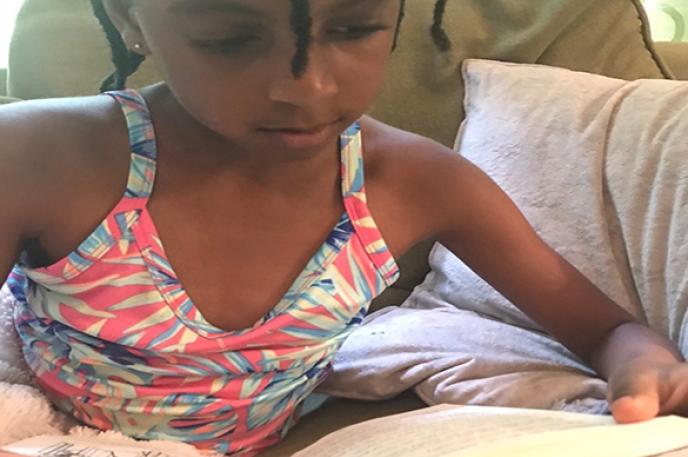
"This was my favorite storytime because you look like me!” Ella exclaimed. “And the girls we read about look like me."
In a world where little Black girls don’t often see themselves reflected in mainstream media and art, something special happened on June 19, 2020. That something was when Tiffany Howard’s eldest daughter felt represented through literature and connected with her University City Regional Library Reading Buddy, Annese.
As the world continues to turn, caught somewhere between reeling and reviving itself from the coronavirus pandemic, the Howard family, like many Charlotte Mecklenburg Library customers, find themselves pivoting to new, virtual ways to enjoy their neighborhood Library. For Tiffany, the gratitude runs deep.
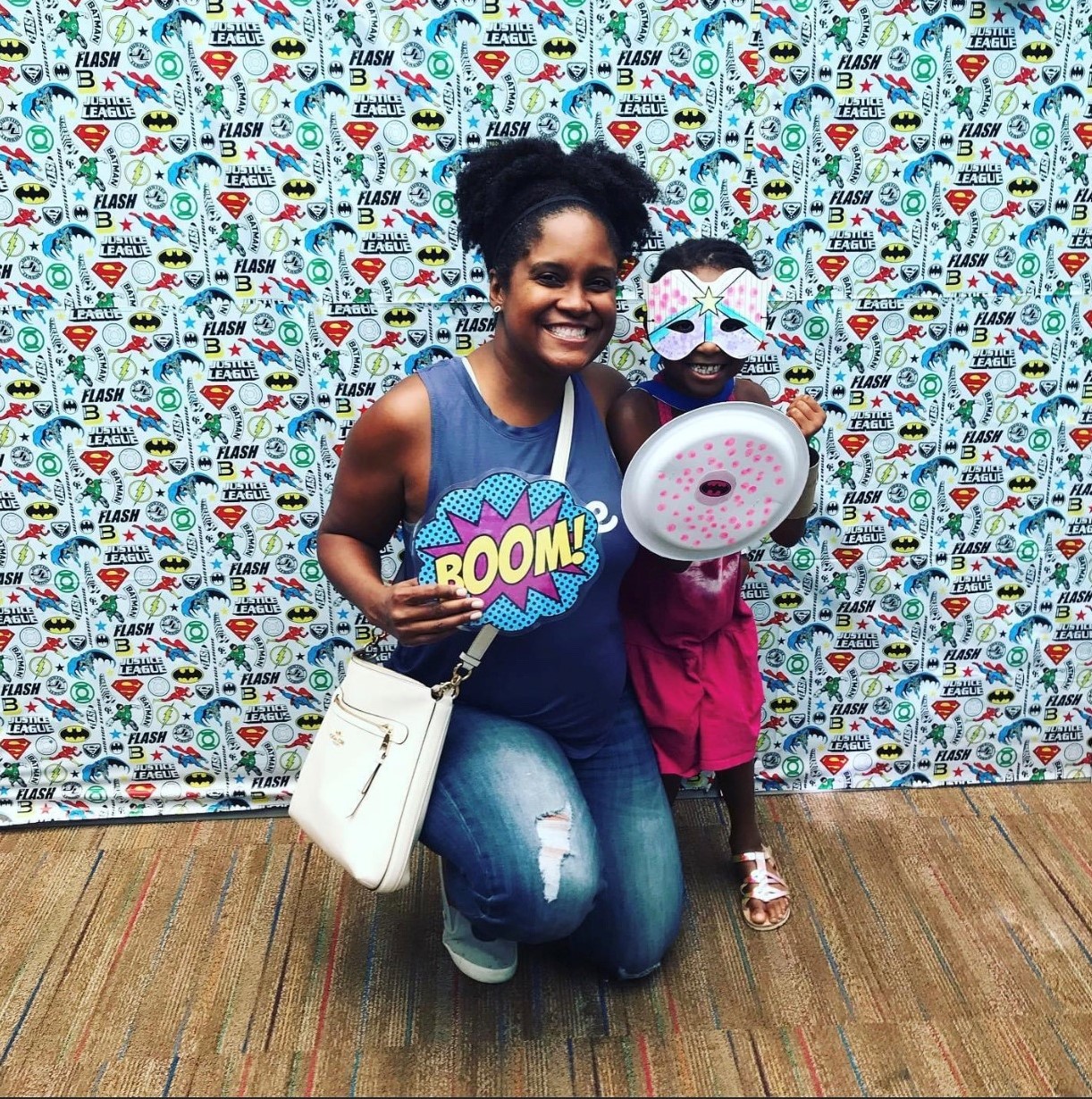 A Charlotte native, psychologist for Charlotte-Mecklenburg Schools, wife and mother to two growing and glowing girls, Ella and Zora (a third grader and first grader, respectively), Tiffany recalls the impact the public library had on shaping her own love for reading while providing her access to an additional education. “The library has always been important to me,” said Howard. “I was excited to pick up books that I’d read while sitting under the cart while my mom did her grocery shopping,” she added.
Literacy and learning weren’t reserved solely for visits to her beloved North Branch Public Library (which opened in 1957 and served the Beatties Ford Road neighborhood) or trips to the grocery store. Reading was also important in her home and to her family. Even her brother would find delight in reading all the books on their great grandmother’s bookshelf. For Tiffany, reading was about self-discovery, and it still is. “We are intentional about finding books that represent our girls, our family, their beauty and our culture,” she said.
Today, Tiffany advocates for public libraries as vital, cultural institutions that provide integral resources to the communities they serve – resources from which she and her family continue to benefit. “We started with baby 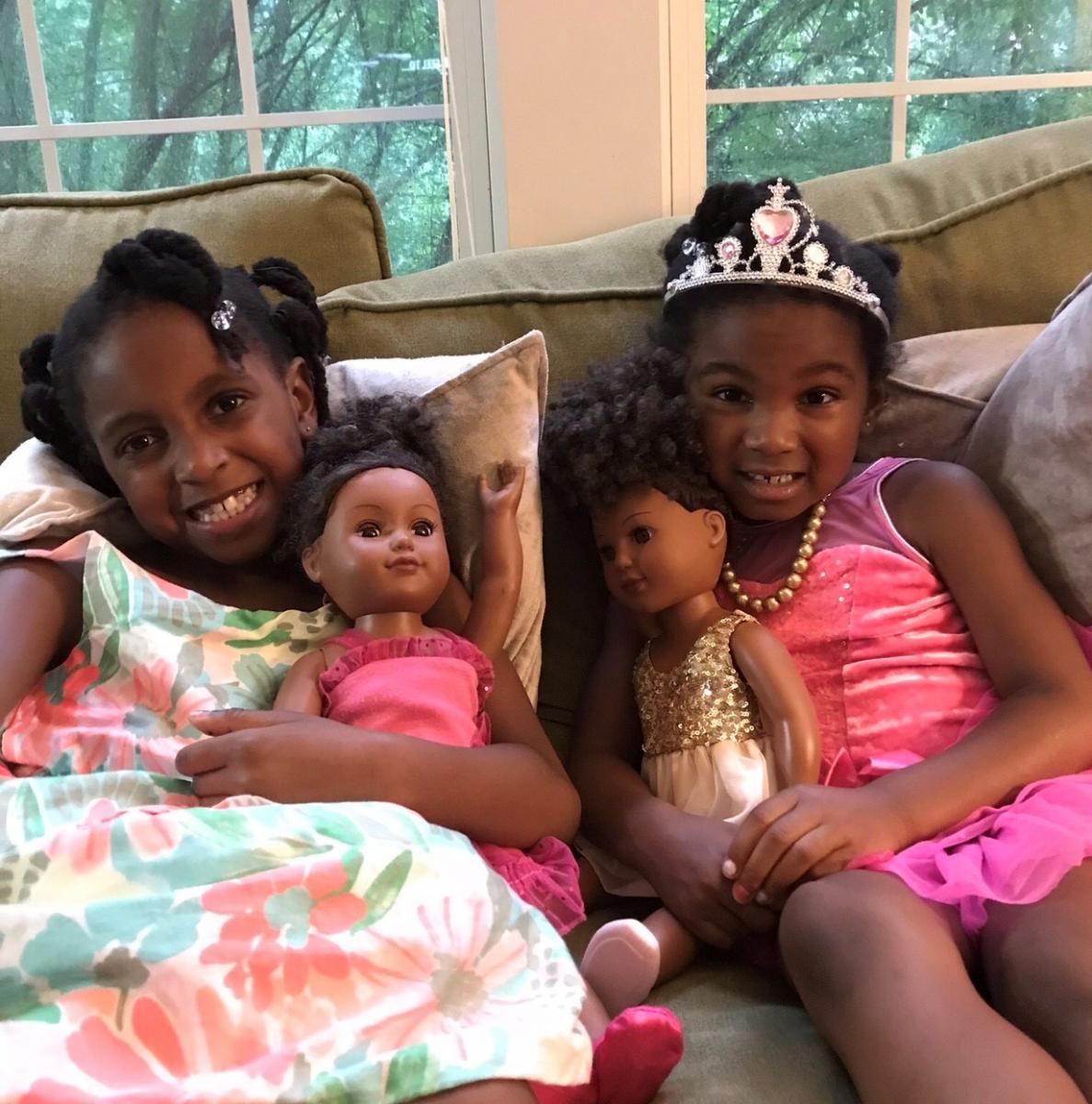 storytime, then we’d go afterschool to check out books,” she said. “Next, we moved to the Reading Buddies program in person and, now, online,” she added.
To others in the community, Tiffany finds herself recommending Library resources – from digital to programming to events, including storytimes, ABCmouse digital resource, the ONE Access program for CMS students and cultural events like the Library’s Black History Month Literary Festival. At that festival in February 2020, Ella received a custom drawing of herself from illustrator Gordon C. James, which is now displayed in her room. Tiffany also attended an Active Reading training a few years ago, which helped her husband develop skills to actively read with their daughters, further deepening their appreciation for library services.
Tiffany sees libraries as equalizers: they are a place for everyone, from all walks of life, and a space to learn and to belong. “Education is the most important tool to change the world and the library makes that possible for all,” she stated. “Libraries promote language, literacy, learning and more.”
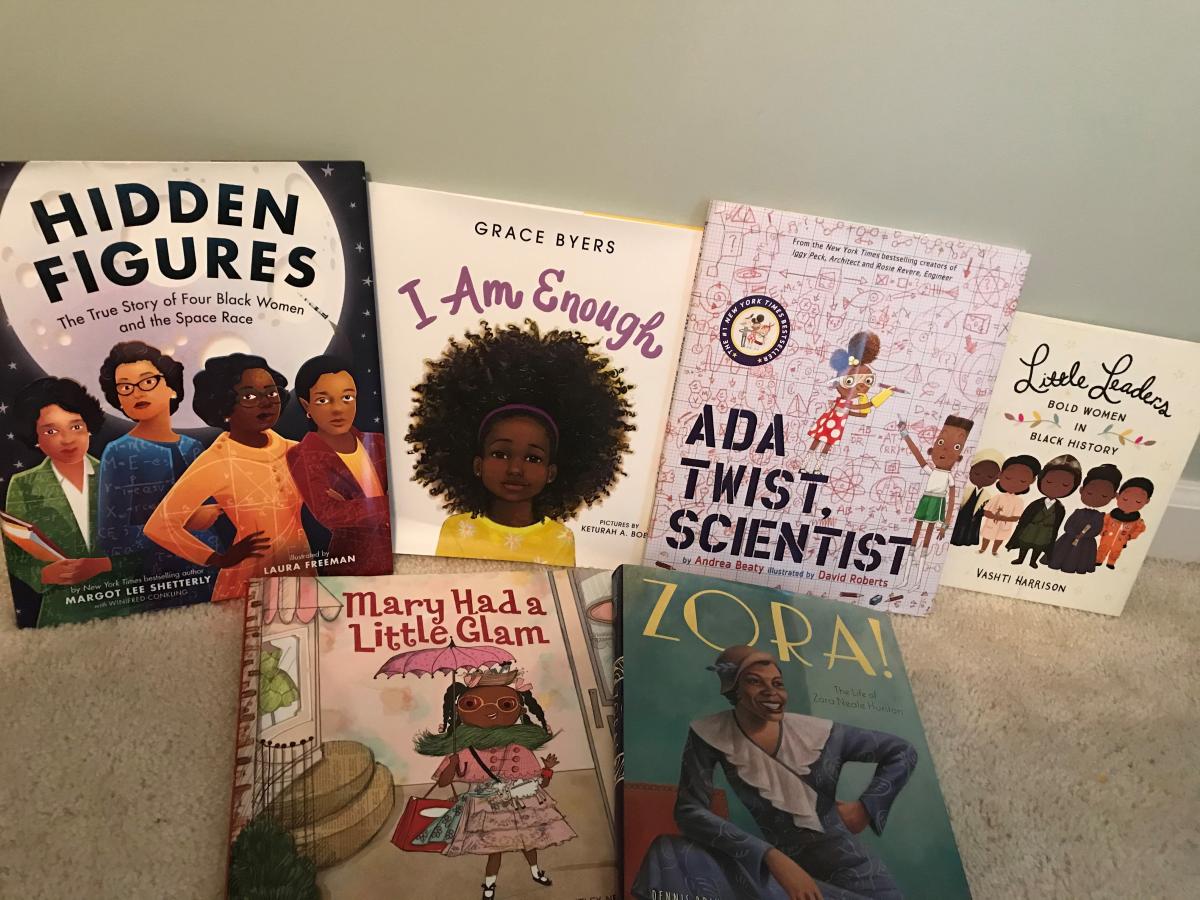 Tiffany describes her daughters as artsy and creative and believes one of the most important things she can leave them with is a passion for reading and a legacy of learning. “It feels good, as a parent and an educator, to know that even when school is out my girls want to go to the Library,” she said.
As for the Reading Buddy session from June, Tiffany said Ella was grateful for the interaction, one-on-one time and the opportunity to see herself represented in a whole new way. “It made her feel special to talk to someone who selected a book and took time to read with her – who just so happened to look like her, too.”
--
This blog was written by Asha Ellison of Charlotte Mecklenburg Library.
Thumbnail
Virtual Programming from the Library - Week of 8/24/20
August 20, 2020
Did you know that you can continue to stay connected to the Library while staying home? How would you like to participate in a virtual storytime with your family or receive resume help all from the comfort of your couch? Join Charlotte Mecklenburg Library every week for a wide range of virtual programming for children, teens and adults. See a complete listing of this upcoming programming for the week of 8/24/2020 below. Click the corresponding links for more information and register for programs where applicable.
Learn more about online programming by clicking here
Monday 8/24
Virtual Reading Buddies – 9 a.m. (Children's programming) register
Family Storytime – 9:30 a.m. (Children's programming) Learn more
Online Listen and Move Storytime – 10:30 a.m. (Children's programming) learn more
Virtual Reading Buddies – 10 a.m. (Children's programming) register
Virtual Reading Buddies – 11 a.m. (Children's programming) register
One-on-One Tutoring and Enrichment – 11 a.m. (Children’s programming) register
Remote Learning 101: Library Resources to Enhance Your Child's Learning – 12 p.m. (Adult programming) register
Mindful Mondays – 12 p.m. (Adult programming) register
Virtual Reading Buddies – 1 p.m. (Children's programming) register
Virtual Reading Buddies – 2 p.m. (Children's programming) register
Book a Librarian – Technology – 2 p.m. (Adult programming) register
One-on-One Tutoring and Enrichment - 2:30 p.m. (Children's programming) register
Virtual Reading Buddies – 3 p.m. (Children's programming) register
Traditional Storytelling – 3 p.m. (Children’s programming) learn more
Stronger Together: Support for your Job Search – 4 p.m. (Adult programming) register
Podcast Discussion Club – 7 p.m. (Adult programming) register
Tuesday 8/25
Virtual Reading Buddies – 9 a.m. (Children's programming) register
Family Storytime – 9:30 a.m. (Children's programming) Learn more
Virtual Reading Buddies – 10 a.m. (Children's programming) register
Cuentos Virtuales en Español - 10:30 a.m. (Children's programming) learn more
Getting Started with Microsoft Word – 11 a.m. (Adult programming) register
Book a Librarian - Business Research – 11 a.m. (Adult programming) register
Virtual Reading Buddies – 11 a.m. (Children's programming) register
One-on-One Tutoring and Enrichment - 11 a.m. (Children's programming) register
Career Development Intensive Coaching – 12 p.m. (Adult programming) register
Career Development Intensive Coaching – 12:30 p.m. (Adult programming) register
Virtual Reading Buddies – 1 p.m. (Children's programming) register
Virtual Reading Buddies – 2 p.m. (Children's programming) register
Book a Librarian - Technology – 2 p.m. register
Story Explorers Enrichment – 2 p.m. (Children's programming) learn more
One-on-One Tutoring and Enrichment – 2:30 p.m. (Children's programming) register
Virtual Reading Buddies – 3 p.m. (Children's programming) register
Wednesday 8/26
Virtual Reading Buddies – 9 a.m. (Children's programming) register
Family Storytime – 9:30 a.m. (Children's programming) Learn more
Virtual Reading Buddies – 10 a.m. (Children's programming) register
Online Listen and Move Storytime – 10:30 a.m. (Children's programming) learn more
Virtual Reading Buddies – 11 a.m. (Children's programming) register
One-on-One Tutoring and Enrichment – 11 a.m. (Children's programming) register
Poetry in Pajamas – 12 p.m. (Adult programming) register
Virtual Reading Buddies – 1 p.m. (Children's programming) register
Virtual Reading Buddies – 2 p.m. (Children's programming) register
Book a Librarian - Technology – 2 p.m. register
One-on-One Tutoring and Enrichment – 2:30 p.m. (Children's programming) register
Virtual Reading Buddies – 3 p.m. (Children's programming) register
Teens LIVE on Instagram: Your Voice Matters – 5 p.m. (Teen programming) learn more
Learning Circle: The 1619 Project – 6 p.m. (Adult programming) register
Thursday 8/27
Virtual Reading Buddies – 9 a.m. (Children's programming) register
Family Storytime – 9:30 a.m. (Children's programming) Learn more
Virtual Reading Buddies – 10 a.m. (Children's programming) register
Cuentos Virtuales en Español - 10:30 a.m. (Children's programming) learn more
Book a Librarian - Business Research – 11 a.m. (Adult programming) register
Virtual Reading Buddies – 11 a.m. (Children's programming) register
One-on-One Tutoring and Enrichment - 11 a.m. (Children's programming) register
Career Development Intensive Coaching – 12 p.m. (Adult programming) register
Career Development Intensive Coaching – 12:30 p.m. (Adult programming) register
Virtual Reading Buddies – 1 p.m. (Children's programming) register
Virtual Reading Buddies – 2 p.m. (Children's programming) register
Caregiver Class: Active Reading Training for Caregivers of K-3 Students – 2 p.m. (Adult programming) register
Book a Librarian - Technology – 2 p.m. register
One-on-One Tutoring and Enrichment – 2:30 p.m. (Children's programming) register
Learning Circle: Foundations of Mindfulness – 3 p.m. (Adult programming) register
Virtual Reading Buddies – 3 p.m. (Children's programming) register
Book Talk: Children's – 3 p.m. (Children's programming) learn more
Caregiver Class: Active Reading Comprehension Strategies for Upper Elementary – 6 p.m. (Adult programming) register
Teens LIVE on Instagram: Eco-Minimalism – 6 p.m. (Teen programming) learn more
Friday 8/28
Virtual Reading Buddies – 9 a.m. (Children's programming) register
Family Storytime – 9:30 a.m. (Children's programming) Learn more
Virtual Reading Buddies – 10 a.m. (Children's programming) register
Baby Storytime – 10:30 a.m. (Children's programming) learn more
Meal Prepping and Planning Made Easy – 11 a.m. (Adult programming) register
Virtual Reading Buddies – 11 a.m. (Children's programming) register
One-on-One Tutoring and Enrichment – 11 a.m. (Children's programming) register
Mindful Friday - Meditation for Wellness – 12 p.m. (Adult programming) register
Learning Circle: How to Be an LGBT+ Ally – 1 p.m. (Adult programming) register
Virtual Reading Buddies – 1 p.m. (Children's programming) register
Virtual Reading Buddies – 2 p.m. (Children's programming) register
Book a Librarian - Technology – 2 p.m. register
One-on-One Tutoring and Enrichment – 2:30 p.m. (Children's programming) register
Virtual Reading Buddies – 3 p.m. (Children's programming) register
Saturday 8/29
Family Storytime – 9:30 a.m. (Children's programming) Learn more
Virtual Reading Buddies – 10 a.m. (Children's programming) register
Virtual Reading Buddies – 11 a.m. (Children's programming) register
Thumbnail

The top five self-help audiobooks for self exploration
August 20, 2020
During this time of uncertainty, many of us are looking at ways to improve ourselves internally. Hoopla has a great selection of self-help audiobooks to help you on your journey. Here are the top five that Charlotte Mecklenburg Library customers have been streaming this month. Discover these titles and so much more. All you need is your Charlotte Mecklenburg Library card or One Access ID number!
Learn more about hoopla and checkout limits here. Need a library card? Sign up here.
Click here to find the self-help audiobooks below in the Library catalog.
Atomic Habits: An Easy & Proven Way to Build Good Habits & Break Bad Ones by James Clear-A Summary/Read by Best Self Audio (2019)
Learn how you can apply the main lessons & principles from Atomic habits: An Easy & Prove Way to Build Good Habits & Break Bad Ones in a quick, easy listen! Run time: 56 minutes
Me and White Supremacy by Layla F. Saad/Read by Author (2020)
Me and White Supremacy teaches readers how to dismantle the privilege within themselves. Run time: 5 hours and 20 minutes
The Power of Vulnerability by Brené Brown/Read by Author (2012)
The author dispels the cultural myth that vulnerability is weakness and reveals that it is, in truth, our most accurate measure of courage. Run time: 6 hours and 31 minutes
How to Win Friends and Influence People: A Condensation From the Book by Dale Carnegie/Read by Jason McCoy (2019)
Learning to relate to people in the ways Carnegie instructs will help you personally as well as professionally. This is a condensation of the original book. Run time: 43 minutes.
The Road Back to You by Ian Morgan Cron and Suzanne Stabile/Read by Ian Morgan Cron (2016)
In The Road Back To You the authors forge a unique approach, a practical, comprehensive way of accessing Enneagram wisdom and exploring its connections with Christian spirituality for a deeper knowledge of God and of ourselves. Run 9 hours and 18 minutes.
--
This blog was written by Serena Guest of Charlotte Mecklenburg Library