Charlotte, North Carolina, was first settled after colonists made their way down the Great Wagon Road. Northern colonies in Pennsylvania, Maryland and Virginia had become crowded, so settlers went south to seek religious and economic freedom, as well as to take advantage of quality farmland. Native Americans used this trail for hunting, trading, and war long before the settlers used it to migrate south. The Native Americans named the trail “Warriors Path.”

Conestoga Wagon, courtesy of Wikimedia.
Before Charlotte was chartered in 1768 by the colonial North Carolina General Assembly, settlers called the area “Charlottetowne” after Queen Charlotte Sophia of Mecklenburg-Strelitz. The settlers sought to honor Queen Charlotte’s husband, King George III, as well as to sway Assemblymen into making Charlotte the site of the county courthouse as a political bid. Courthouses enabled cities to grow economically by serving as a hub for visitors and business during quarterly sessions. The Assemblymen chartered the city of Charlotte in 1768 and entitled the city to a courthouse and a prison.
The charter reads:
“Be it therefore Enacted, by the Governor, Council, and Assembly, and by the Authority of the same, That the said Three Hundred and Sixty Acres of Land, so laid off by the Commissioners or Trustees as aforesaid, be, and the same is hereby constituted, erected, and established, a Town and Town Common, and shall be called by the name of Charlotte.”
-- Acts of the North Carolina General Assembly, 1768; North Carolina. General Assembly; November 07, 1768 - December 05, 1768; Volume 23, Pages 759-783; CHAPTER XI.

1766- The First Mecklenburg County Courthouse (modern interpretation). Courtesy of the Robinson-Spangler Carolina Room.
Mecklenburg County, the county in which the city of Charlotte exists, was also named in honor of Queen Charlotte. Charlotte’s birthplace was Mecklenburg-Strelitz, which is a province in present-day northern Germany. Queen Charlotte never actually visited our city, but one of her handwritten letters is housed at the Robinson-Spangler Carolina Room in the Main Library:

Queen Charlotte Letter, 1812. Courtesy of Charlotte Mecklenburg Library, Robinson-Spangler Carolina Room.
Who was Queen Charlotte anyway?

George III (1738-1820), Queen Charlotte (1744-1818) and their Six Eldest Children. Courtesy of Zoffany Royal Collection Trust/© Her Majesty Queen Elizabeth II, 2014.
Queen Charlotte Sophia was born in Mecklenburg-Strelitz (in the Holy Roman Empire) in 1744, to Duke Charles Louis Frederick of Mecklenburg and Princess Elisabeth Albertine of Saxe-Hildburghausen. As a child, she was educated by a priest in botany, natural history and language, but focused her studies in housekeeping and religion. As demonstrated by the letter above, Charlotte learned how to read and write. These were rare skills for women during that time—her royal status permitted her to have access to education through multiple tutors.

Unfinished portrait depicting the marriage of George III to Charlotte of Mecklenburg-Strelitz on 8 September 1761, Sir Joshua Reynolds. Courtesy of Royal Collection Trust.
At 17 years old in 1761, Charlotte was engaged to King George III. She was an attractive option to wed because she was born in an “insignificant” part of Europe and would likely have no interest in politics; she was instructed by George III after their wedding “not to meddle” in politics, which she obeyed. However, she did have indirect political influence—she used her closeness to George III to keep herself informed and to recommend office appointments, as well as keep German interests in mind. She did not speak English at first but learned quickly. One observer commented, "She is timid at first but talks a lot, when she is among people she knows."

View of Buckingham House from WH Pyne, The History of the Royal Residences, 1819 (Courtesy of the British Library).
Although St. James Palace was the official Royal residence, Queen Charlotte fell in love with Buckingham House, which she and George III moved into shortly after purchasing. She gave birth to 14 of her 15 children in the house that eventually became known as “The Queen’s House.” This property is now popularly known as Buckingham Palace.

Wolfgang Amadeus Mozart Opus 3 Dedication Page. Courtesy of Bibliorare.
Queen Charlotte had a passion for music, so she brought a harpsichord with her from Germany and took lessons from Johann Christian Bach, son of Johann Sebastian Bach. Wolfgang Amadeus Mozart once played the organ as Queen Charlotte sang on a family trip to England when he was 8 years old. Mozart later dedicated his Opus 3 to his beloved queen. On the dedication page he wrote, “Filled with pride and joy at daring to offer you a tribute, I was finishing up these sonatas to be laid at the feet of your Majesty [Queen Charlotte]; I was, I confess, drunk with vanity and thrilled with myself, when I spied the Genius of Music at my side.”

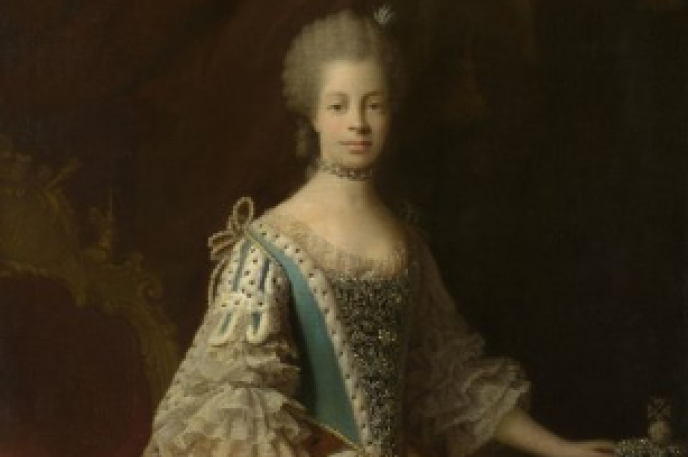
Queen Charlotte (1744-1818) by Sir Allan Ramsay, ca. 1761-1769. Courtesy of Royal Collection Trust, https://www.rct.uk/collection/402413/queen-charlotte-1744-1818
According to some genealogists, Queen Charlotte is informally considered the second biracial Queen of England. She was purportedly a direct descendent of Margarita de Castro e Sousa, a member of the African branch of the Portuguese Royal House. Early portraits of the Queen show that Charlotte had hints of African physical attributes. Sir Allan Ramsay painted many portraits of Queen Charlotte, seen above. Writings from the period also alluded to her “mulatto” appearance, meaning “one with mixed black and white ancestry.”
As anti-slavery movements in England became more prevalent, royal portrait painters were instructed to soften “undesirable” features in their subjects’ faces. This included making Queen Charlotte’s skin tone appear lighter and manipulating other physical features. In fact, Ramsay’s Coronation portrait of Charlotte was distributed in England and the colonies to subtly stoke anti-slavery sentiment due to the prevalence of Charlotte’s African features.

A photo of Kew Gardens, the royal botanical garden Queen Charlotte helped maintain. Photo by Kew Gardens.
Queen Charlotte had a keen interest in botany and played a large role in expanding and preserving Kew Gardens, the Royal botanical gardens in Kew, England. She was known by the British public as the “Queen of Botany,” and botanists named the Bird of Paradise, a flower native to South Africa, the Strelitzia reginae in her honor. Charlotte turned to botany when she struggled with her mental health, which is when she planned the gardens of the Frogmore House in Windsor.
Queen Charlotte was also a philanthropist, founding several orphanages in England. She founded and was named the Patron of the General Lying-in Hospital in London, which was later named The Queen’s Hospital and is now known as The Queen Charlotte’s and Chelsea Hospital. Queen Charlotte was also known to offer aid to poor families, as well as helped struggling musicians.
--
Sources:
Blakemore, Erin. “Meghan Markle Might Not Be the First Mixed-Race British Royal.” History. https://www.history.com/news/biracial-royalty-meghan-markle-queen-charlotte. Accessed August 2019.
Cooper, Jean L. and Angelika S. Powell. “Queen Charlotte’s Letters.” http://people.virginia.edu/~jlc5f/charlotte/letter_intro.html. Accessed August 2019.
“England’s 18th Century Black Queen, Sophie Charlotte born.” AAREG. https://aaregistry.org/story/englands-first-black-queen-sophie-charlotte-born/. Accessed August 2019.
Fraser, Flora. “Princesses: The Six Daughters of George III.” New York: Knopf, 2005. (CML Call No. 941.073 Fraser)
Hanchett, Tom. “The History of Charlotte.” Charlotte. https://www.charlottesgotalot.com/articles/history/the-history-of-charlotte. Accessed August 2019.
Hedley, Olwen. “Queen Charlotte.” London: J. Murray, 1875. (NCR B C479c H455)
“History Timeline, Rural Beginnings 1730-1772, 1776- The First Mecklenburg County Courthouse.” Charlotte Mecklenburg Story. https://www.cmstory.org/exhibits/history-timeline-rural-beginnings-1730-1772/1766-first-mecklenburg-county-courthouse. Accessed August 2019.
“History Timeline, Rural Beginnings 1730-1772, 1768- Charlotte Chartered.” Charlotte Mecklenburg Story. https://www.cmstory.org/exhibits/history-timeline-rural-beginnings-1730-1772/1768-charlotte-chartered. Accessed August 2019.
Jackson, Marshall R., III. “Great Wagon Road.” NCPedia. https://www.ncpedia.org/great-wagon-road. Accessed August 2019.
“Queen Charlotte (19 May 1744- 17 November 1818.” The Royal Family. https://www.royal.uk/. Accessed August 2019.
Valdes y Cocom, Mario de. “The Blurred Racial Lines of Famous Families: Queen Charlotte.” South Carolina etv. https://www.pbs.org/wgbh/pages/frontline/shows/secret/famous/royalfamily.html.
Walk-Morris, Tatiana. “Five Things to Know About Queen Charlotte.” Smithsonian Magazine. https://www.smithsonianmag.com/smartnews-arts-culture/5-things-you-didnt-know-about-queen-charlotte-180967373/. Accessed August 2019.




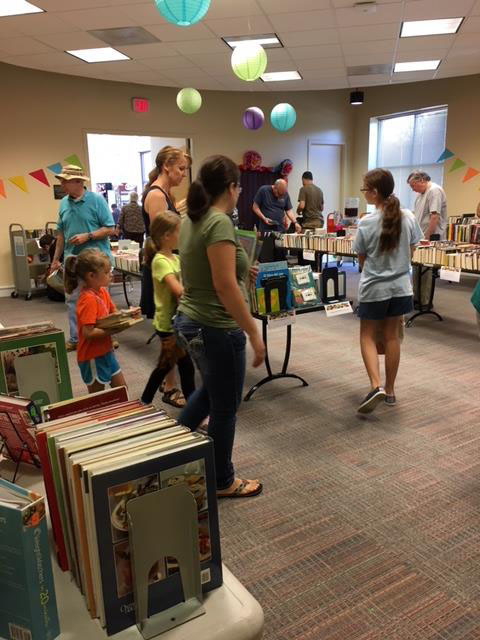 Why buy books where you can borrow them for free? Library staff member Helaine Kranz explains: “People are looking for something special. Some are teachers or parents, building a classroom or home library. Others are collectors, looking for an unexpected treasure. One customer found a vinyl record she’d been searching for, another purchased a signed copy of Jimmy Carter’s autobiography. It’s the Library version of Pawn Stars – you never know what you’ll find!”